
This earthy and umami Rice Cooker Meal with Burdock Root is a God-send meal when you feel lazy! One-pot and zero-stove cooking required. 💯

Jump to:
This rice cooker meal is a riff on takikomi gohan (炊き込みご飯), or Japanese mixed rice dish made with different kinds of vegetables and animal proteins (sometimes also referred to as gomoku gohan or 五目ご飯), and mostly inspired by my laziness in cooking sometimes (or a lot of times).
Feeling Soupy? Instant Pot Burdock Root Soup is another one-pot recipe and requires zero stove cooking!
Want some protein? Stir-Fried Burdock Root with Eggs is a quick and easy, crowd-pleasing, protein-packed dish!
Burdock Root in Chinese
Burdock root is called Niú Bàng (牛蒡) or Niú Bàng Gēn (牛蒡根) in Chinese, with the former being more commonly used (Gēn or 根 means roots).
What is Burdock Root?


Appearance: Burdock roots, native to Europe and Asia, look and smell a bit similar to ginseng and are sometimes referred to as oriental ginseng (actual ginsengs are mostly produced in North America, particularly in the American state of Wisconsin and the Canadian province of Ontario) while being much cheaper and with more culinary uses.
Taste and Texture: Raw burdock root tastes like a less bitter and more earthy version of daikon radish and is drier in texture than daikon radish. Depending on how it is cooked, burdock roots can taste quite similar to bamboo shoots (slightly sweet and earthy) but their texture can be quite dry and takes some chewing power (not as tender as bamboo shoots).
Burdock roots have traditionally been used as a blood purifier and topical remedy for skin conditions. In Traditional Chinese Medicine (TCM), the seeds of the greater burdock plant and its roots are considered to have a cooling effect when consumed. And "cool" foods are believed to help reduce excess internal heat and fight inflammation in the body.
It is a well-known food ingredient in Chinese cooking, but seems to be much more popular among Japanese home cooks, which is why you might see more Japanese recipes for burdock roots, most notably kinpira gobo (braised burdock roots with carrots).
You will most likely find fresh burdock root only in Asian grocery stores.
Ingredient Notes And Substitutions
Here is a quick overview of what you'll need! Find the printable recipe with measurements below.
Jump to Recipe
- Burdock Roots: Similar to potatoes, burdock root's skin is edible but I prefer to peel it.
- Shiitake Mushrooms: I prefer to use fresh shiitake mushrooms but you can also use dried shiitake mushrooms.
- Substitution: Not recommended.
- Carrots: Melt-in-your-mouth and so delicious after being cooked! And adds a pop of color to this dish.
- Substitution: Not recommended. Burdock roots and carrots are a (root vegetable) match made in heaven (or IN earth?)!
- Peas: The perfect pairing to carrots, with contrasting colors and different textures.
- Substitution: You can substitute for corn if you don't like peas. Better yet, use both peas and corn!
- Rice Sauce: This sauce is essential for bringing everything in this dish together! Substitution is not recommended.
- Light Soy Sauce: I feel like light soy sauce hits the front part of your tongue and adds to the initial savory taste.
- Dark Soy Sauce: I feel like dark soy sauce hits the back part of your tongue (closer to where your mouth and nasal cavities join), which adds to the aroma and the overall savory profile! It also enhances the brown coloring.
- Sesame Oil: Adds to the natural sweet earthy aroma and flavor profile of this dish.
- Sugar: To counterbalance the saltiness of the two kinds of soy sauces.
- Rice: White medium to short-grain rice would work best in terms of taste (it absorbs the flavors from all the other ingredients well) and texture (unless you are like me and enjoy the chewiness from brown rice—and can use the extra fiber!).
- I use white medium-grain rice in this recipe.
- Substitution: You can substitute for brown rice or semi-brown rice. Just make sure to use an adequate amount of water according to how they are cooked.
- Water: Equal cups of cold water to the cups of rice used, or however instructed by your rice cooking machine based on the type of rice you use.
- Substitution: You can substitute for partial dashi stock and reduce the tablespoon of soy sauce used.
- (Optional Addition) Sesame Seed: Sprinkle some white sesame seeds on top of the rice for a nutty enhancement!
- (Optional Addition) Green Onion: Sprinkle some chopped green onions on top of the rice to brighten up the dish, both in color and taste!
How To Make This Recipe: A Visual Guide
Here is a quick visual rundown! Find the full instructions with ingredients below.
Jump to Recipe
Step 1: Julienne the burdock roots.

Step 2: Julienne the carrot.

Step 3: Slice the shiitake mushrooms.

Step 4: In a rice cooker pot, add rice, tap water, stir to wash the rice, and discard the water. Repeat until the water becomes clearer, about 2-3 rounds.

Step 5: Prepare the rice for cooking with drinking water as you normally would.

Step 6: In a small mixing bowl, add dark and light soy sauce, sesame oil, and sugar. Mix until the sugar particles are mostly dissolved.

Step 7: Add half of the sauce you had just prepared to the rice cooker pot, and mix well.

Step 8: Layer on burdock root strips, carrot strips, sliced mushrooms, and peas on top of the rice and DO NOT MIX.

Step 9: Drizzle the remaining half of the sauce onto the vegetables and start the rice cooking process.

Step 10: When the rice is done cooking, open the lid, stir, and mix the cooked rice and vegetables. Close the lid and let the rice sit for another 2-3 minutes before serving.
Rice Cooking Tips (MUST READ!)
- Portion the rice sauce - ½ for flavoring rice and ½ for flavoring vegetables
- Prepare the rice for cooking as you normally would. For example, I use medium-grain white rice and a 1:1 rice-to-water ratio in my Zojirushi rice cooker.
- Add half of the rice sauce to the rice and MIX WELL. This ensures all the rice grains will be properly cooked with the sauce-integrated water.
- Make sure the rice is properly submerged in enough liquid.
- Drizzle the remaining half of the rice sauce onto the vegetables and DO NOT MIX. Not mixing at this step is crucial as the rice is best cooked when properly submerged in an adequate amount of liquid. If you mix everything, some rice will come out not fully cooked.
Recipe Help and Common Questions
Burdock root can last 2-3 weeks if wrapped with damp paper towels and saran wrap (or in an airtight bag).
You can store any leftovers in an airtight container for 3 to 4 days. Reheat them in the microwave or on the stovetop (steam or pan-fried).

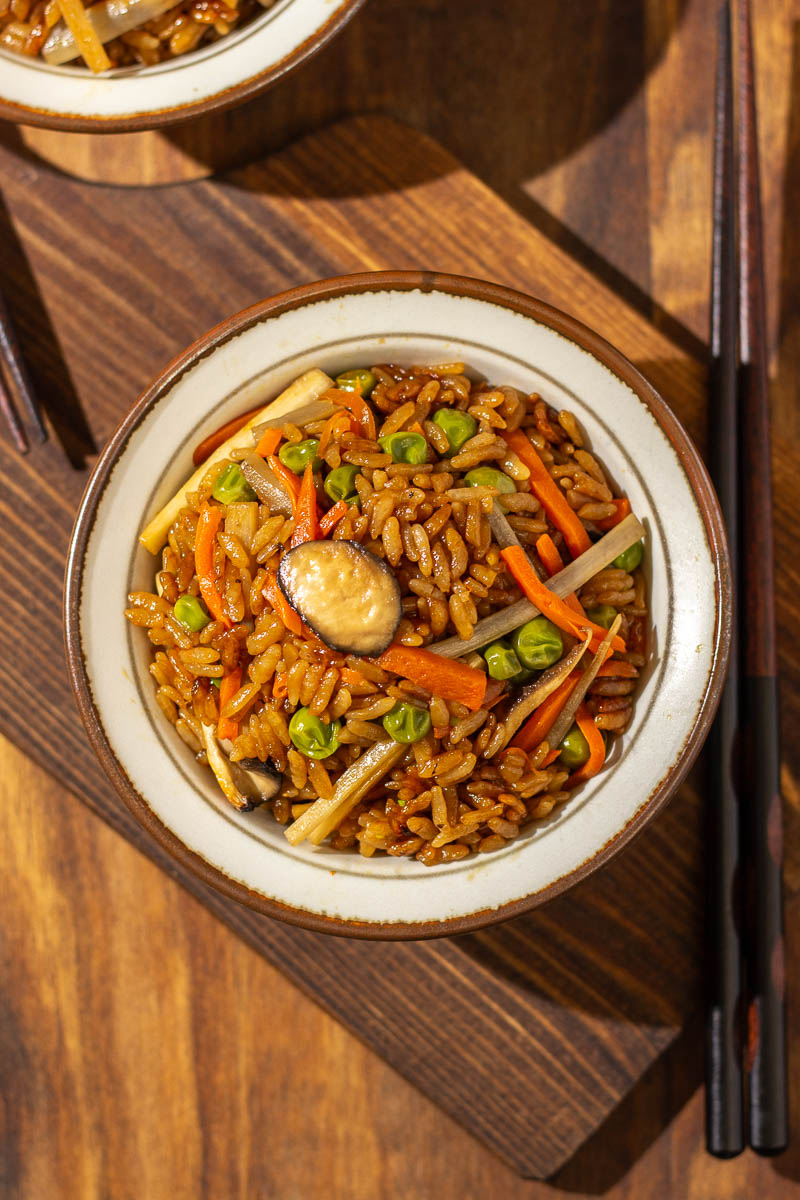
One-Pot Rice Cooker Meal with Burdock Root
Equipment
- 1 Rice Cooker I use a Zojirushi rice cooker
Ingredients
- 1 cup white rice
- 1 cup water for rice cooking
- 1 stick burdock root julienned
- ½ medium carrot julienned
- 3 pieces shiitake mushrooms sliced
- ½ cup peas I use frozen
Rice Sauce
- 2 tablespoons light soy sauce
- ½ tablespoon dark soy sauce
- ½ tablespoon sesame oil
- ½ teaspoon sugar
Instructions
For Preparing the Produce
- Rinse 1 stick burdock root under water to remove any dirt, and peel.Cut the burdock root into shorter sections, then into thin slices, then into matchstick-like strips.
- Do the same with ½ medium carrot.
- Rinse 3 pieces shiitake mushrooms under water to remove any dirt, and cut them into slices.
For Making the Rice Sauce
- In a small mixing bowl, add 2 tablespoons light soy sauce, ½ tablespoon dark soy sauce, ½ tablespoon sesame oil, ½ teaspoon sugar, and mix well.
For Making the Rice Cooker Meal
- In a rice cooker pot, add and wash 1 cup white rice. Use your hand to stir and wash the rice. The water will turn milky, discard the milky water, and repeat the process until the water becomes mostly clear, about 2-3 rounds.
- Prepare the rice for cooking as you normally would. I use medium-grain white rice, a 1:1 water-to-rice ratio, and therefore 1 cup water.
- Add ½ of the rice sauce you had just prepared to the uncooked rice, and mix well.
- Lay the burdock roots, carrots, shiitake mushrooms, and ½ cup peas on top of the uncooked rice, and do not mix.Not mixing at this step is very important as the rice is best cooked when fully submerged in an adequate amount of liquid. If you mix everything, the water will be more evenly distributed amongst all the ingredients (versus just with the rice), and some rice will come out not fully cooked.
- Drizzle the remaining ½ of the rice sauce on top of the laid vegetables. Again, DO NOT MIX.
- Press the "Cooking / Reheat" setting to begin the rice cooking process.
- Once the rice is done cooking, open the rice cooker, use a rice paddle to stir and mix the cooked rice and vegetables, and select the "Keep Warm" setting.
- Close the lid to let the rice "cook" for another 2-3 minutes. If you don't have the "Keep Warm" setting, just close the lid and wait for another 2-3 minutes.
Serve and enjoy!
Notes
Nutrition
Nutrition is hand-calculated using Cronometer, and should be treated as an estimate only. Values can vary based on the ingredients, brands, and quantities you use. For the most accurate results, please calculate the nutrition using the exact ingredients you use, or consult a qualified healthcare professional or registered dietitian.
zelin Yang says
That look very delicious! I wish I can eat it one day !☺️😃